What Is a Transverse Wave?Definition, Diagram, Properties & Real-Life Examples
A transverse wave is a wave where the medium moves perpendicular to the direction the wave travels. Shake a rope up and down — the wave moves forward, but the rope only moves up and down.
↕ Medium moves ⊥ to wave direction ↔A transverse wave is a wave where the medium oscillates perpendicular (at right angles) to the direction the wave travels. Light, radio waves, guitar string vibrations, water ripples, and seismic S-waves are all transverse waves. The five key properties are amplitude, wavelength, frequency, period, and wave speed, connected by the equation v = f × λ. Unlike longitudinal waves (such as sound), transverse waves can be polarized. Electromagnetic transverse waves travel through vacuum at 299,792,458 m/s. Mechanical transverse waves require a solid medium.
Perpendicular motion is the defining feature
A transverse wave is a wave in which the displacement of the medium is perpendicular to the direction of wave propagation. The word "transverse" comes from the Latin transversus, meaning "lying across."
Hold one end of a long rope and flick your wrist up, then down. A bump travels along the rope from your hand toward the far end. The wave moves horizontally, but the rope itself only moves vertically. That right-angle relationship between wave direction and particle motion is the defining feature of every transverse wave — on strings, water surfaces, seismic S-waves, and all electromagnetic radiation including light.
In a transverse wave, nothing in the medium moves in the direction the wave is going. Only energy moves forward. The particles of the medium stay in place, oscillating around their rest position.
Are transverse waves perpendicular?
Yes. Perpendicular motion is the defining property. In a transverse wave, the oscillation of the medium (or field) is always at 90 degrees to the direction of wave propagation. The words "perpendicular" and "transverse" describe the same relationship in this context.
If a wave travels horizontally to the right, the medium moves up and down, or in any direction within the plane perpendicular to travel. It never moves forward or backward along the wave's path.
This perpendicular geometry is what makes transverse waves polarizable. A polarizing filter can select one specific perpendicular direction of oscillation and block all others. Longitudinal waves oscillate parallel to propagation, so there is no perpendicular component to filter. Polarization is physically impossible for them.
When a physics question asks "are transverse waves perpendicular," the answer is not just yes. Perpendicularity is the single property that separates transverse waves from every other wave type.
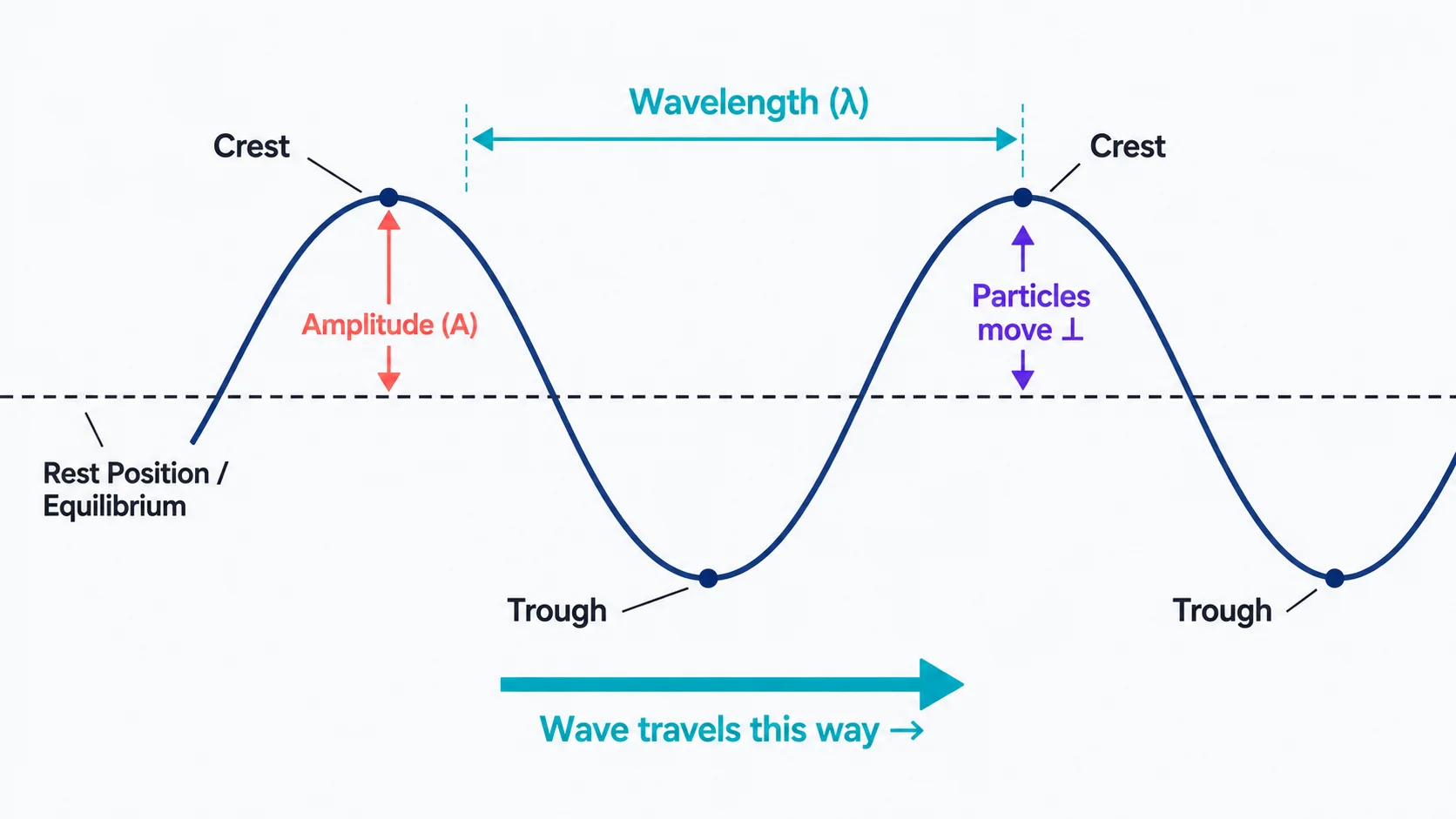
Labeled transverse wave diagram
Every transverse wave shares the same anatomy, whether it travels on a string, through water, or as an electromagnetic field.
Five properties describe every transverse wave
| Property | Symbol | Unit | What it measures |
|---|---|---|---|
| Amplitude | A | metres (m) | Max displacement from rest; determines energy |
| Wavelength | λ | metres (m) | Distance between consecutive identical points |
| Frequency | f | hertz (Hz) | Cycles per second |
| Period | T | seconds (s) | Time for one cycle; T = 1/f |
| Wave Speed | v | m/s | Propagation speed; v = fλ |
The medium doesn't travel — only energy does
When you shake one end of a rope, each segment moves up and down. No piece of rope travels from your hand to the other end. What moves forward is the disturbance — the pattern of displacement — and with it, the energy you put into the wave.
Watch a floating leaf on a pond after you drop a stone. The ripples move outward, but the leaf just bobs up and down — it doesn't travel toward the shore.
At the crest or trough, the particle is momentarily stationary. It has reached its maximum displacement, and the restoring force is at its strongest, pulling it back toward equilibrium. At this instant, all of the wave's energy at that point is stored as elastic potential energy.
At the equilibrium position, the particle moves at its fastest speed. The restoring force is zero because the particle is at its rest position, but it carries maximum momentum. At this instant, all energy is kinetic.
This constant exchange between kinetic and potential energy at every point along a transverse wave follows the same pattern as a mass bouncing on a spring. The connection is not just an analogy. The restoring force that drives both systems obeys Hooke's law: the force pulling a displaced particle back toward equilibrium is directly proportional to how far it has been displaced (F = −kx, where k is the stiffness and x is the displacement). A stiffer medium (higher k) produces a stronger restoring force and a faster wave. A heavier medium (more mass per unit length) resists acceleration and slows the wave down. This is exactly the physics captured in the string wave speed formula v = √(T/μ), where tension provides the restoring force and linear mass density provides the inertia.
Mechanical vs. electromagnetic
Mechanical Transverse Waves
Need a medium whose particles can oscillate and that can support shear stress — which is why they travel through solids but generally not through liquids or gases.
Rope waves · guitar strings · seismic S-waves · water ripples
Electromagnetic Transverse Waves
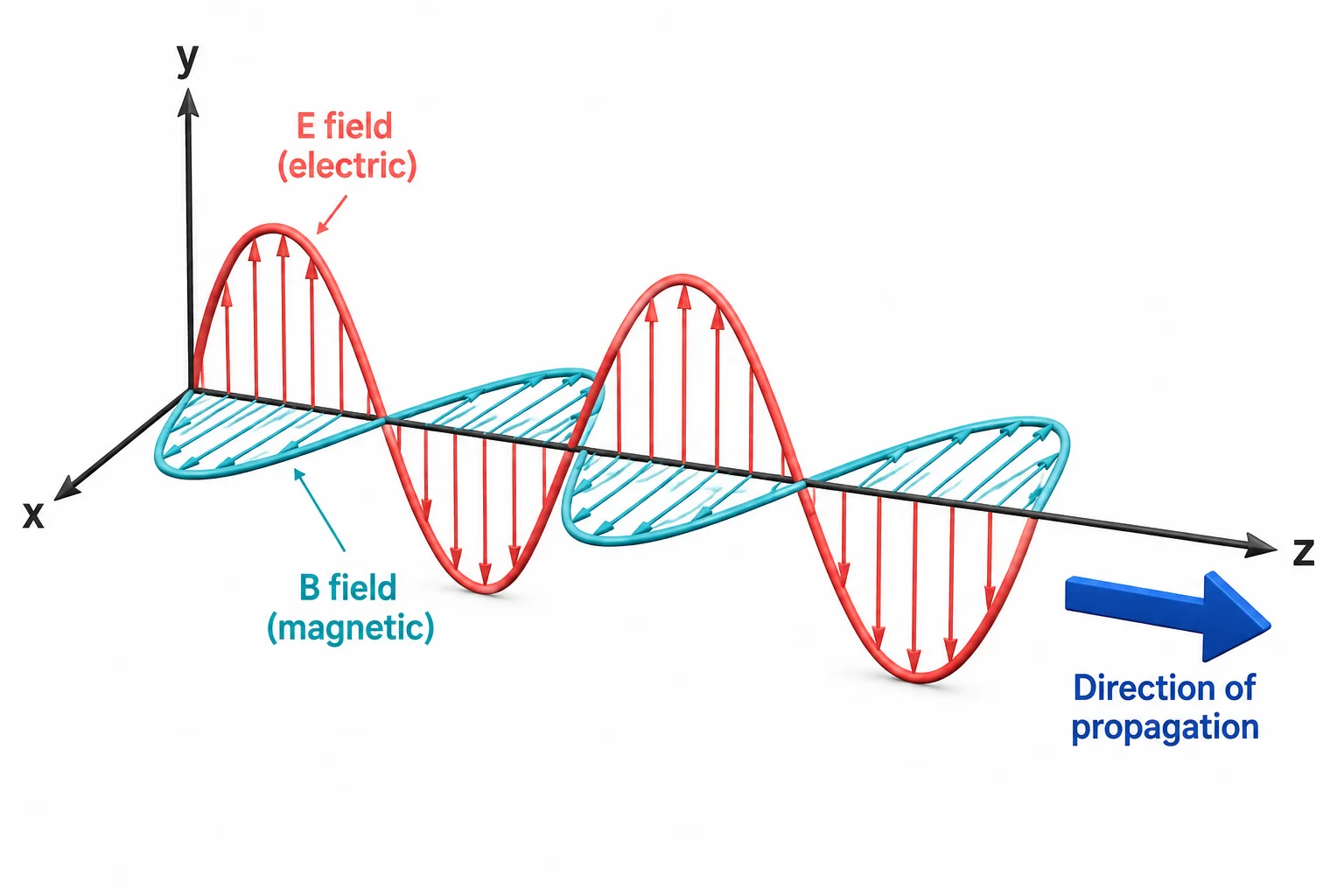
Oscillating electric and magnetic fields that regenerate each other as they propagate — no medium required. The electric field, magnetic field, and direction of travel are all mutually perpendicular.
Light · radio waves · X-rays · gamma rays
Do transverse waves need a medium?
Not always. This is one of the most important distinctions in wave physics, and the answer depends on whether the wave is mechanical or electromagnetic.
Mechanical transverse waves absolutely require a medium. They are physical oscillations of matter: atoms or molecules displacing sideways and pulling their neighbours along with them. A rope wave needs the rope. A seismic S-wave needs solid rock. Without a material medium, there is nothing to oscillate.
Critically, the medium must be able to resist shear forces. Shear resistance means the material pushes back when you try to slide one layer past another. Solids do this. Liquids and gases do not — they simply flow. This is why mechanical transverse waves travel through steel, rock, and wood, but not through water's interior, air, or any other fluid.
Electromagnetic transverse waves need no medium at all. They are not oscillations of matter — they are oscillations of electric and magnetic fields that regenerate each other through Maxwell's equations. Light from the Sun crosses 150 million kilometres of empty space to reach Earth. Radio signals travel to satellites orbiting in vacuum. No material substance carries them.
This difference explains a fact that surprises many students: you can see the Sun (light is a transverse EM wave that crosses vacuum), but you could never hear it, even if it were making sound. Sound is a longitudinal wave that requires a medium. Space is a vacuum. No medium, no sound.
Transverse waves are everywhere
Transverse waves appear everywhere once you know what to look for — from everyday objects to cutting-edge science.
Ripples on Water
Drop a pebble into a still pond. The ripples that spread outward are predominantly transverse at the surface. Each water molecule near the surface moves up and down (perpendicular to the wave direction) as the wavefront passes.
However, water waves are more complex than simple textbook transverse waves. In deep water, individual molecules actually trace small elliptical or circular paths rather than moving purely up and down. At the surface, the motion is mostly vertical (transverse). Deeper below the surface, the ellipses flatten out until the motion becomes negligible — surface water waves are "approximately transverse" at the surface but not purely so throughout the full depth.
For exam purposes, ripples on water are classified as transverse waves because the dominant visible motion at the surface is perpendicular to wave travel. But the full picture involves a combination of transverse and longitudinal components, which is why some physics references call them "surface waves" rather than purely transverse.
Transverse Waves in Solids
Unlike fluids, solid materials can support shear stress. When one layer of a solid is displaced sideways relative to its neighbours, internal elastic forces pull it back. This restoring mechanism is what allows transverse mechanical waves to propagate through solids.
This property has major practical applications. Ultrasonic transverse waves are used in non-destructive testing (NDT) to inspect the internal structure of solid objects without cutting them open. Engineers send transverse wave pulses into metal beams, aircraft fuselages, bridge components, and pipelines. If the wave encounters a crack, void, or material boundary inside the object, it reflects back — by analysing the timing and intensity of these reflections, inspectors can locate internal defects with millimetre precision.
This is also why seismic S-waves travel through Earth's solid mantle and crust but stop completely at the liquid outer core. The liquid iron of the outer core cannot support shear stress, so the transverse oscillation has no restoring force and the wave simply ceases to exist at that boundary.
Light & All Electromagnetic Radiation
Every colour you see, every X-ray at a hospital, every microwave heating your food, and every radio signal carrying a podcast is a transverse electromagnetic wave. All electromagnetic waves travel at the same speed in a vacuum (≈3×10⁸ m/s), differing only in wavelength and frequency. Visible light occupies a tiny sliver of the spectrum, between roughly 400 nm (violet) and 700 nm (red).
Guitar Strings & Musical Instruments
Plucking a guitar string creates a transverse wave: the string vibrates up and down while the wave energy travels along it between the fixed ends, producing standing wave patterns whose frequencies determine pitch. A guitar's high E string has a linear mass density of about 3.09×10⁻⁴ kg/m; under 56.40 N of tension, waves travel along it at roughly 427 m/s. The note A₄ corresponds to a string vibrating at exactly 440 Hz.
Seismic S-Waves (Earthquake Waves)
During an earthquake, P-waves (longitudinal) arrive first at 6–13 km/s. S-waves (transverse, shear waves) arrive second at 3–6 km/s, shearing rock sideways and causing much of the destructive side-to-side shaking. Crucially, S-waves cannot travel through liquids — a property that led to one of geology's greatest discoveries.
The Stadium Wave (La Ola)
When fans stand and sit in sequence, the "wave" travels around the arena at roughly 12 m/s (about 20 seats per second). Each person only moves vertically while the wave pattern moves horizontally around the stadium — a perfect large-scale demonstration of transverse wave motion.
The math behind the wave
The universal wave equation connects speed, frequency, and wavelength for every wave in physics:
For a wave on a string — the simplest, most visual transverse wave example in physics — speed depends on tension and mass per unit length:
This reveals two practical insights. Increasing tension makes the wave faster — exactly why tightening a guitar string raises its pitch. And a heavier string produces slower waves, which is why the thick bass strings on a guitar produce lower notes than the thin treble strings.
Worked Example
A guitar string has a tension of 80 N and a linear mass density of 0.005 kg/m. What is the wave speed?
v = √(80 / 0.005) = √16,000 ≈ 126.5 m/s
Worked Example
A transverse wave has a frequency of 200 Hz and a wavelength of 0.5 m. What is its speed?
v = f × λ = 200 × 0.5 = 100 m/s
Transverse waves that need no medium
Light is a transverse wave — and so is every other form of electromagnetic radiation. Unlike waves on a rope, electromagnetic waves need no physical medium; they propagate through the complete vacuum of space. The electric field oscillates in one plane, the magnetic field oscillates in a perpendicular plane, and the wave moves perpendicular to both.
The mechanism relies on two laws working in a continuous loop. Faraday's law of electromagnetic induction states that a changing magnetic field creates an electric field in the surrounding space. Ampère's law, with a crucial correction added by Maxwell himself, states that a changing electric field creates a magnetic field. Maxwell's correction was the addition of what he called the "displacement current," a term representing the effect of a time-varying electric field. Without this single term, the equations describe static fields. With it, they predict self-propagating transverse waves.
The cycle works like this: the oscillating electric field generates a changing magnetic field beside it. That changing magnetic field generates a new electric field a little further along. That new electric field generates another magnetic field, and so on. The two fields continuously create each other, leapfrogging forward through space at the speed of light. No material medium is needed because the fields themselves are the medium. This mutual regeneration is why electromagnetic transverse waves can cross the vacuum of space while sound (which needs physical particles to compress) cannot.
James Clerk Maxwell predicted this in 1864 when his derived wave equation matched the known speed of light almost exactly. Heinrich Hertz confirmed it experimentally in 1887, generating and detecting radio waves that reflected, refracted, interfered, and polarized exactly as Maxwell's theory predicted.
- Radio waves
- Microwaves
- Infrared
- Visible light
- Ultraviolet
- X-rays
- Gamma rays
Every type of electromagnetic wave travels at c ≈ 299,792,458 m/s in a vacuum, differing only in wavelength and frequency. The energy of a single photon is given by E = hf, where h is Planck's constant (6.626×10⁻³⁴ J·s) — higher frequency means higher energy, which is why gamma rays are dangerous while radio waves are harmless.
For each band's wavelength, frequency and photon energy, an interactive spectrum explorer and the history of how each was discovered, see the electromagnetic spectrum.
The property only transverse waves have
An unpolarized transverse wave vibrates in all directions perpendicular to its travel path. A polarizing filter passes only the component vibrating in one plane. This is physically impossible for longitudinal waves — there's no "sideways" component to restrict. You can't polarize sound.
French engineer Étienne-Louis Malus discovered polarization in 1808 when he noticed that light reflected from a glass plate had asymmetric properties depending on viewing angle — one of the key pieces of evidence that eventually led physicists to realize light must be transverse.
When two polarizers are aligned (θ = 0°), all light passes through. When perpendicular (θ = 90°), none does.
Polarization drives major industries. LCD screens in phones, laptops, and TVs control every pixel by rotating the polarization of light through liquid crystals. Polarized sunglasses filter horizontally polarized glare reflected from roads, water, and car hoods. 3D cinema projects two images at different polarization angles so each eye sees a slightly different picture, creating depth. Fiber optic telecommunications rely on polarization management to transmit data as light through glass fibres — the global fiber optics market was worth roughly $8–9 billion in 2025, projected to exceed $17 billion by 2035. Quantum cryptography uses the polarization states of individual photons for theoretically unbreakable encryption — the BB84 protocol encodes information in two polarization bases of transverse light waves.
The core difference: the angle between motion and travel
In a transverse wave, particles move perpendicular to wave propagation — think of a rope wave: the rope moves up and down, the wave moves left to right, a 90° angle. In a longitudinal wave, particles move parallel to wave propagation — think of sound in air: molecules compress and expand in the same direction the sound travels, with no sideways motion.
| Property | Transverse Wave | Longitudinal Wave |
|---|---|---|
| Particle motion | Perpendicular to wave direction | Parallel to wave direction |
| Wave features | Crests and troughs | Compressions and rarefactions |
| Can be polarized? | Yes | No |
| Needs a medium? | Electromagnetic types: no | Always |
Is sound a transverse wave? No — sound is a longitudinal wave. Air molecules compress and expand in the direction sound travels, with no perpendicular oscillation, which is why sound cannot be polarized.
That is the short version. For the full matrix, the maths the two share, the waves that are somehow both, and how to tell them apart in an exam, see transverse vs longitudinal waves.
How transverse waves mapped Earth's interior
Seismic S-waves — the transverse waves generated by earthquakes — gave scientists a detailed map of Earth's inner structure without ever drilling deeper than 12 kilometres.
An earthquake sends out two body waves. P-waves (primary, longitudinal) arrive first at 6–13 km/s. S-waves (secondary, transverse) follow at 3–6 km/s. Crucially, S-waves cannot travel through liquid — liquids can't support the shear stress a transverse wave requires. Seismologists noticed that beyond 103° from an earthquake's epicentre, S-waves completely disappeared. This "shadow zone" (103°–180°) proved that Earth's outer core, starting at a depth of about 2,900 km, is liquid.
In 1936, Danish seismologist Inge Lehmann went further. Analysing data from a 1929 New Zealand earthquake, she noticed faint P-waves arriving inside the shadow zone, where the liquid-core model predicted none. She proposed that a solid inner sphere — roughly 1,220 km in radius, mostly nickel-iron — sits nested inside the liquid outer core, refracting some P-waves into the shadow zone. Her three-page paper, titled simply "P′," was confirmed in 1970; the boundary is now called the Lehmann Discontinuity. The deepest borehole ever drilled, Russia's Kola Superdeep Borehole, reached only about 12 km — everything else we know about Earth's interior comes from wave physics.
| Layer | Depth |
|---|---|
| Crust | 0 – ~35 km |
| Mantle | ~35 – 2,900 km |
| Outer Core (liquid) | 2,900 – 5,150 km |
| Inner Core (solid) | 5,150 – 6,371 km (radius ~1,220 km) |
When transverse waves reflect
When a transverse wave hits a fixed boundary — like the end of a guitar string — it reflects back and overlaps with the incoming wave, forming a standing wave: a pattern that oscillates in place rather than travelling. Fixed points that never move are called nodes; points of maximum oscillation between them are antinodes.
A string fixed at both ends can only vibrate at frequencies where a whole number of half-wavelengths fits exactly between the ends. The lowest is the fundamental; higher integer multiples are harmonics (or overtones). The specific mix of harmonics a string produces determines its timbre — why a guitar sounds different from a violin playing the same note. This is the physical basis of every stringed and wind instrument.
Key equations summary
This quick reference collects every important formula related to transverse waves in one place.
Wave interference and superposition
When two transverse waves meet in the same medium, their displacements add together — a principle called superposition. Constructive interference happens when two crests (or troughs) arrive together, adding amplitudes into a larger wave; if two identical waves meet perfectly in phase, the amplitude doubles. Destructive interference happens when a crest meets an equal trough — the displacements cancel and the medium doesn't move at all.
These principles explain the bright and dark fringes in Thomas Young's 1801 double-slit experiment, the shimmering colours in soap bubbles and oil films, and the resonant frequencies of musical instruments. Noise-cancelling headphones use destructive interference directly: a microphone picks up ambient sound, and the headphone generates the exact inverse wave (180° out of phase) — the two cancel in your ear canal, and you hear silence.
The double-slit experiment: interference proves waves
Thomas Young's double-slit experiment, first performed in 1801, remains one of the most important demonstrations in physics. It proved that light behaves as a wave by showing interference — a property that particles cannot produce.
The setup is simple. A beam of light passes through two narrow slits close together in an opaque barrier. On a screen behind the barrier, instead of two bright lines (which particles would produce), an alternating pattern of bright and dark bands appears. The bright bands occur where waves from the two slits arrive in phase (constructive interference, crests meeting crests). The dark bands occur where waves arrive out of phase (destructive interference, crests meeting troughs).
This pattern only makes sense if light is a wave that can spread out from each slit and overlap. When the experiment is done with a single colour of light, the spacing of the bright fringes directly reveals the wavelength — red light (longer wavelength) produces wider spacing, violet light (shorter wavelength) produces narrower spacing.
The double-slit experiment does not by itself prove light is transverse rather than longitudinal — both wave types can produce interference. The transverse proof came later through polarization experiments by Fresnel and Arago, which showed that two beams polarized at right angles to each other do not interfere at all — a result that only makes sense for transverse waves with two independent perpendicular oscillation directions.
350 years of transverse wave theory
The story of transverse waves spans centuries and some of the most famous names in physics — from a debate about the nature of light to the structure of the Earth and the fabric of spacetime itself.
- 1665Robert Hooke suggests in Micrographia that light vibrations might be perpendicular to propagation — the earliest hint of a transverse wave.
- 1675Isaac Newton publishes his corpuscular theory, arguing light is a stream of tiny particles. His authority keeps this view dominant for over a century.
- 1678Christiaan Huygens presents a wave theory of light, proposing the "luminiferous aether" and what's now known as Huygens' Principle.
- 1801Thomas Young's double-slit experiment demonstrates light interference — strong evidence for wave behaviour, though largely ignored for a decade.
- 1808Étienne-Louis Malus discovers polarization in light reflected from a glass plate and coins the term "polarization."
- 1817Young and Fresnel independently conclude that light waves must be transverse, not longitudinal as had been assumed.
- 1821Augustin-Jean Fresnel mathematically proves light is entirely transverse, with zero longitudinal component.
- 1850Léon Foucault measures the speed of light in water and finds it slower than in air, as the wave theory predicted — a decisive blow against Newton's particle theory.
- 1864James Clerk Maxwell unifies electricity and magnetism, derives a wave equation, and predicts electromagnetic waves travelling at the speed of light.
- 1887Heinrich Hertz generates and detects radio waves in his laboratory, confirming Maxwell's transverse-wave prediction experimentally.
- 1936Inge Lehmann discovers Earth's solid inner core by analysing seismic P-waves arriving inside the S-wave shadow zone.
- 2015On September 14, LIGO directly detects gravitational waves for the first time — transverse ripples in spacetime itself, predicted by Einstein a century earlier. The signal, GW150914, came from two merging black holes (36 and 29 solar masses) 1.3 billion light-years away, stretching LIGO's 4 km arms by ~4×10⁻¹⁸ m. The discovery earned the 2017 Nobel Prize in Physics.
The Wave vs Particle Debate (1665–1800)
In 1665, Robert Hooke proposed in his work Micrographia that light vibrations might be perpendicular to the direction of propagation. This was the earliest suggestion of what we now call a transverse wave. However, Hooke's ideas were not fully developed.
In 1675, Isaac Newton published his corpuscular theory, arguing that light consists of tiny fast-moving particles. Newton's immense reputation meant this view dominated scientific thinking for over a century.
In 1678, Dutch physicist Christiaan Huygens presented a competing wave theory of light to the French Academy of Sciences, later published in his Traité de la lumière (1690). Huygens proposed that light travels as waves through an invisible medium he called the "luminiferous aether." He developed what is now known as Huygens' Principle: every point on a wavefront acts as a source of secondary spherical wavelets.
Despite the elegance of Huygens' model, Newton's authority kept the particle theory dominant until the early 1800s.
The Transverse Breakthrough (1801–1821)
In 1801, Thomas Young performed his landmark double-slit experiment, demonstrating that light produces interference patterns. This was strong evidence for wave behaviour, since particles could not produce such patterns. Yet Young's work was largely ignored for over a decade.
The turning point came when Augustin-Jean Fresnel developed a rigorous mathematical wave theory of diffraction in 1816 and submitted it to the French Academy in 1819. In a famous twist, Siméon Denis Poisson, a supporter of the particle theory, tried to disprove Fresnel's mathematics by predicting an absurd consequence: a bright spot should appear in the exact centre of a circular shadow. François Arago performed the experiment, and the bright spot was found. Fresnel won the prize, and the wave theory gained serious ground.
The story of Poisson's spot deserves emphasis because it is one of the great ironies in physics history. Poisson was certain that Fresnel's wave theory must be wrong. He worked through the mathematics specifically looking for a flaw and found what he believed was an absurd prediction: light should appear in the very centre of a perfectly circular shadow, where common sense says there should be total darkness. Poisson presented this as proof of the theory's failure. But when Arago actually performed the experiment, the bright spot was there, exactly as Fresnel's mathematics predicted. The very argument designed to destroy the wave theory became its strongest confirmation.
The final conceptual leap came in 1817, when both Thomas Young and Augustin Fresnel independently concluded that light waves must be transverse, not longitudinal as had been assumed. This explained polarization, which had puzzled physicists since Malus's discovery in 1808. By 1821, Fresnel mathematically proved that polarization could only be explained if light was entirely transverse, with zero longitudinal component.
Fresnel's contributions extended beyond pure theory. In 1821, he invented the Fresnel lens, a compact lens design that uses concentric prismatic rings to focus light over wide angles. This invention was immediately adopted in French lighthouses, dramatically increasing the visible range of their beacons and saving countless lives at sea. The Fresnel lens was a direct practical outcome of understanding transverse wave optics, and variations of the design are still used today in lighthouses, overhead projectors, and vehicle tail lights.
Foucault's Measurement: The Final Blow to the Particle Theory (1850)
In 1850, French physicist Léon Foucault performed an experiment that settled the wave vs particle debate decisively. He measured the speed of light in water and found it was slower than in air.
This was the key test. Newton's corpuscular theory predicted that light particles would accelerate as they entered a denser medium (pulled in by the medium's attraction), meaning light should travel faster in water than in air. Huygens' wave theory predicted the opposite: waves should slow down in a denser medium, just as sound does.
Foucault's result matched the wave prediction exactly. Light moves slower in water. Combined with Young's interference patterns and Fresnel's diffraction mathematics, this measurement convinced the scientific community that light must be a wave. The corpuscular theory was abandoned until 1905, when Einstein's photoelectric effect showed that light also has particle-like properties, leading to the modern understanding of wave-particle duality.
Maxwell, Hertz, and the Electromagnetic Age (1864–1887)
In 1864, James Clerk Maxwell published his equations unifying electricity and magnetism. He derived a wave equation and calculated the speed of electromagnetic waves. The result matched the measured speed of light. Maxwell concluded that light is an electromagnetic wave, transverse in nature.
In 1887, Heinrich Hertz generated and detected radio waves in his laboratory. He proved these waves exhibited reflection, refraction, interference, and polarization, exactly as Maxwell predicted for transverse electromagnetic waves. This was the definitive confirmation.
LIGO and Gravitational Waves (2015)
On September 14, 2015, the Laser Interferometer Gravitational-Wave Observatory (LIGO) made the first direct detection of gravitational waves. These are transverse waves of spacetime itself, predicted by Einstein's general relativity in 1915 but never directly observed until a century later.
The signal, named GW150914, came from the merger of two black holes (36 and 29 solar masses) roughly 1.3 billion light-years away. Three solar masses of energy (approximately 5.4 × 10⁴⁷ joules) was radiated as gravitational waves. The waves stretched and compressed LIGO's 4 km detector arms by about 4 × 10⁻¹⁸ metres, roughly one two-hundredth of the radius of a proton.
Gravitational waves are transverse: they stretch space in one direction and simultaneously compress it in the perpendicular direction. Their detection opened an entirely new window for observing the universe and earned the 2017 Nobel Prize in Physics.
LIGO's first observation run (O1) spanned 130 days from September 2015 to January 2016 and detected three gravitational wave events. Scaling that detection rate to a full year suggests roughly five detectable events annually at O1 sensitivity. When Advanced LIGO reaches its design sensitivity (a threefold improvement in signal-to-noise ratio), the observable volume of space increases 27 times, potentially yielding over 100 gravitational wave events per year.
Third-generation detectors currently being planned, such as the Einstein Telescope in Europe, aim for another tenfold sensitivity increase. This would expand the observable volume by a factor of 1,000, potentially detecting around 100,000 gravitational wave events annually. Each of those events involves transverse waves of spacetime rippling across billions of light-years.
Not just a classroom concept
Telecommunications & Fiber Optics
Every internet signal in a fiber optic cable is a transverse light wave bouncing through total internal reflection. The global fiber optics market reached roughly $8–9 billion in 2025, growing 7–10% annually toward $17 billion by 2035. The optical fiber polarizer market alone was worth $10.72 billion in 2025, and polarization-maintaining fibres represent a $320 million niche growing at 10.8% per year.
Display Technology
LCD screens control every pixel by manipulating the polarization of transverse light waves passing through liquid crystal layers. Over 1.5 billion smartphones are sold annually — virtually all using display technology built on transverse wave polarization.
Medical Imaging
X-rays — transverse electromagnetic waves with wavelengths between 0.01 and 10 nanometres — pass through soft tissue while being absorbed by bone. CT scans, mammography, and dental imaging all rely on this transverse radiation.
Seismology & Earthquake Engineering
Analysis of transverse S-waves remains the primary tool for mapping subsurface geology. Oil and gas exploration, earthquake hazard assessment, and non-destructive testing of bridges, pipelines, and aircraft all depend on how transverse waves travel through materials.
Worked examples & practice problems
Example 1: Frequency from Period
A transverse wave has a period of 0.004 seconds. What is its frequency?
f = 1 / T = 1 / 0.004 = 250 Hz
Example 2: Wave Speed from Frequency & Wavelength
A transverse wave has a frequency of 500 Hz and a wavelength of 0.8 m. Calculate the wave speed.
v = f × λ = 500 × 0.8 = 400 m/s
Example 3: String Wave Speed from Tension & Density
A string has a tension of 50 N and a linear mass density of 0.002 kg/m. Find the wave speed.
v = √(T/μ) = √(50/0.002) = √25,000 ≈ 158.1 m/s
Example 4: How Amplitude Affects Energy
If the amplitude of a transverse wave is tripled while frequency stays the same, by what factor does the energy change?
Energy ∝ A². Tripling amplitude: 3² = 9 — energy increases by a factor of 9.
Example 5: Wavelength of Visible Light
Green light has a frequency of approximately 5.7 × 10¹⁴ Hz. Calculate its wavelength.
λ = c / f = (3×10⁸) / (5.7×10¹⁴) ≈ 5.26×10⁻⁷ m = 526 nm
Frequently asked questions
What is a transverse wave in simple words?
A transverse wave is a wave where the material it passes through moves at right angles to the direction the wave travels. Shake a rope up and down — the wave goes sideways along the rope, but the rope itself only moves up and down.
What are five examples of transverse waves?
Light and all electromagnetic radiation, waves on a vibrating guitar string, ripples on the surface of water, seismic S-waves during earthquakes, and the stadium "Mexican wave" at sporting events.
Is sound a transverse wave?
No. Sound is a longitudinal wave — air molecules compress and expand in the same direction the sound travels, so there's no perpendicular oscillation and sound cannot be polarized.
Is light a transverse wave?
Yes. Light is a transverse electromagnetic wave — the electric and magnetic fields oscillate perpendicular to each other and to the direction of propagation. Polarization is the strongest proof.
What are the main parts of a transverse wave?
The crest (highest point), the trough (lowest point), the amplitude (max displacement from equilibrium), the wavelength (distance from one crest to the next), and the equilibrium line (the undisturbed rest position).
Can transverse waves travel through a vacuum?
Electromagnetic transverse waves (light, radio, X-rays) can, because they're oscillations of fields, not matter. Mechanical transverse waves (rope waves, S-waves) cannot — they need particles in a medium to oscillate.
Why can't transverse waves travel through liquids?
Mechanical transverse waves need a medium that resists shear forces. Liquids and gases flow instead of pushing back, which is why seismic S-waves stop at Earth's liquid outer core.
What is the frequency of a transverse wave?
The number of complete cycles passing a fixed point per second, in hertz. Visible light ranges from about 4.3×10¹⁴ Hz (red) to 7.5×10¹⁴ Hz (violet); a guitar's A₄ string vibrates at 440 Hz.
Do transverse waves transfer matter?
No. They transfer energy. Particles oscillate around a rest position and don't travel with the wave — a floating leaf bobs up and down as ripples pass but doesn't move toward shore.
What is a transverse wave diagram?
A labeled illustration showing a sine-shaped curve with the crest, trough, amplitude, wavelength, equilibrium line, and direction of propagation clearly marked — one of the most frequently tested visuals in physics.
How did transverse waves help discover Earth's core structure?
Seismic S-waves (transverse) can't pass through liquid. When they vanished beyond 103° from an earthquake's epicentre, seismologists concluded Earth's outer core is liquid. In 1936 Inge Lehmann found faint P-waves inside that shadow zone and proposed a solid inner core — confirmed in 1970.
What does an unlabeled transverse wave look like?
A smooth S-shaped curve (sine wave) drawn along a horizontal line, with alternating peaks above and valleys below a central axis. Without labels, you can still identify it as transverse by the sine wave shape — the medium oscillating up and down while the wave pattern extends left to right. Exams often give an unlabeled diagram and ask you to mark the crest, trough, amplitude, wavelength, and equilibrium line.
How is a transverse wave different from a surface wave?
A pure transverse wave oscillates strictly perpendicular to propagation. A surface wave, such as a wave on the ocean surface, combines transverse and longitudinal motion — water molecules near the surface trace elliptical paths with both vertical and horizontal components. Surface waves are sometimes called a hybrid of the two types, though ripples are classified as transverse for most introductory purposes since the dominant visible motion is perpendicular to travel.
Who discovered that light is a transverse wave?
Thomas Young and Augustin-Jean Fresnel independently reached this conclusion in 1817. Young proposed it first in a letter to Fresnel, suggesting polarization could be explained if light vibrated at right angles to its direction of travel. Fresnel then developed the mathematical framework and, by 1821, proved light must be entirely transverse. Étienne-Louis Malus's 1808 discovery of polarization had provided the key experimental evidence that pointed them toward the transverse model.
The essentials
Transverse waves are defined by perpendicular oscillation: the medium moves at right angles to the wave's travel direction. This single property gives rise to polarization, determines which materials transverse waves can pass through, and connects concepts from guitar strings to gravitational waves.
Light, radio, X-rays, and every form of electromagnetic radiation are transverse waves — they need no medium and travel at 299,792,458 m/s in a vacuum. Mechanical transverse waves like vibrating strings and seismic S-waves need a solid medium that can support shear stress.
The universal wave equation v = fλ applies to all transverse waves. Wave speed on a string follows v = √(T/μ). Energy scales with the square of amplitude.
From Huygens' wave theory in 1678 to LIGO's detection of gravitational waves in 2015, transverse wave physics has driven some of the most important discoveries in science — and underpins industries worth tens of billions of dollars, from fiber optic telecommunications to display technology.
Explore transverse waves further
Transverse vs Longitudinal
Compare the two fundamental wave families side by side.
→Longitudinal Waves
Compressions, rarefactions, and the physics of sound.
→Interactive Simulator
Drag amplitude, frequency, and wavelength and watch the wave respond.
→Wave Calculator
Plug in values and solve v = fλ instantly.
→Take the Quiz
Test what you've learned about transverse waves.
→Electromagnetic Spectrum
From radio waves to gamma rays, explored in depth.
→Seismic S-Waves
How transverse waves mapped Earth's liquid core.
→