Home Longitudinal Waves

Wave Physics, Visualized

What Is a Longitudinal Wave?Definition, Diagram, Properties & Real-Life Examples

A longitudinal wave is a wave in which the particles of the medium move back and forth parallel to the direction the wave travels. Push and pull one end of a Slinky — the coils squeeze together and stretch apart along the same line the pulse moves.

↔ Particles vibrate along the direction of travel →

A longitudinal wave is a wave where the medium oscillates parallel to the direction the wave travels, creating alternating regions of compression (particles squeezed together) and rarefaction (particles spread apart). Sound, ultrasound and seismic P-waves are all longitudinal waves. The five key properties are amplitude, wavelength, frequency, period and wave speed, connected by v = f × λ. Unlike transverse waves such as light, longitudinal waves cannot be polarized and always require a medium, which is why sound cannot travel through the vacuum of space.

Definition

Parallel motion is the defining feature

A longitudinal wave is a wave in which the displacement of the medium happens parallel to the direction of wave propagation. The particles oscillate back and forth along the same axis the wave moves, rather than at right angles to it. Because these waves squeeze and stretch the medium as they pass, they are also called compression waves, compressional waves or pressure waves.

The clearest way to picture this is a Slinky lying on a table. Push and pull one end horizontally and you send a pulse of compressed coils travelling down its length. Each individual coil moves only a short distance forward and back, but the pattern of compression travels all the way to the far end.

The same behaviour applies to sound in air, pressure waves in water, seismic P-waves through solid rock, and vibrations along a spring. In every case the medium oscillates along the line of travel, and the wave carries energy forward without carrying the particles along with it.

If the particles move along the direction of travel, the wave is longitudinal. If they move across it, the wave is transverse. That single geometric distinction separates the two fundamental types of wave in physics.

Anatomy of a Wave

Compressions and rarefactions

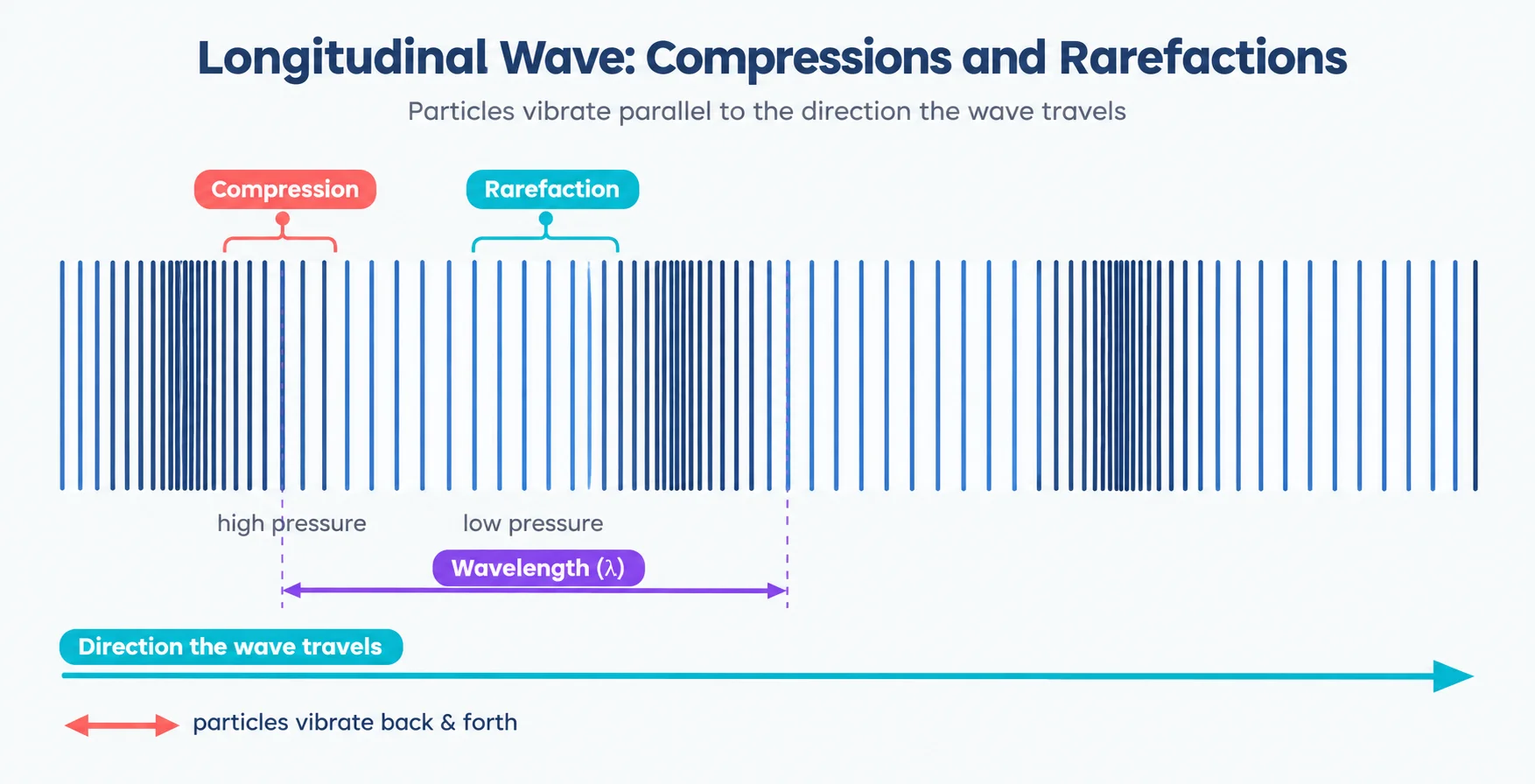
Longitudinal waves have no crests and troughs. They are built from two alternating regions instead. A compression is where the particles are pushed close together, raising the density and pressure above normal. A rarefaction is where they are pulled apart, dropping density and pressure below it. Understanding these two zones is the key to understanding every longitudinal wave.

Labeled longitudinal wave diagram showing particles bunched into a compression at high pressure, spread apart into a rarefaction at low pressure, the wavelength measured from one compression to the next, and arrows for the direction of travel and the back-and-forth particle motion
Compression to compression is one wavelength. The particles themselves only shuffle back and forth — it is the pattern that moves right.

Try it yourself

Drag the controls to see how amplitude, wavelength and frequency reshape the same wave. The labels track the real compression centres as they travel.

Wave speed2.00m/sv = f × λ
Period1.00secondsT = 1 / f
Compressions / sec1.0passing a fixed point= f

The drawing clamps amplitude so particles never pass through each other. Real sound waves are far gentler than this: a conversation displaces air molecules by billionths of a metre against wavelengths around a metre.

Compression

Particles pushed close together. Density is higher than normal and pressure rises above the surrounding medium. These are the high-pressure peaks of the wave.

Rarefaction

Particles pulled apart. Density is lower than normal and pressure drops below the surrounding medium. These are the low-pressure valleys of the wave.

A vibrating source — a loudspeaker cone, a guitar body — pushes nearby particles together to make a compression, then pulls back to make a rarefaction. That push and pull repeats many times per second, sending a continuous train of pressure variations outward. The energy in the wave sets how extreme the zones become: a more energetic wave squeezes its compressions tighter and spreads its rarefactions wider, which your ear reads as a louder sound.

Properties

Parts of a longitudinal wave

Even though longitudinal waves look different from transverse waves, they are measured with the same five quantities. These fully describe any longitudinal wave and are what you need to solve any related physics problem.

PropertySymbolUnitWhat it measures
AmplitudeAmetres (m)Max particle displacement from rest; sets loudness. Energy ∝ A²
Wavelengthλmetres (m)Distance between the centres of two consecutive compressions
Frequencyfhertz (Hz)Cycles per second; sets pitch
PeriodTseconds (s)Time for one cycle; T = 1/f
Wave Speedvm/sPropagation speed; v = fλ

Amplitude (A)

Amplitude measures how far the particles move from their rest position at the peak of their oscillation. For a sound wave it can equally be described as the difference between the normal density of the medium and the density at the centre of a compression. Larger amplitude means more energy, and for sound that means greater loudness. Energy is proportional to the square of the amplitude, so doubling the amplitude carries four times the energy.

Wavelength (λ)

Wavelength is the distance between two consecutive identical points on the wave. For a longitudinal wave that means from the centre of one compression to the centre of the next, or equally from one rarefaction to the next. It is measured in metres and written with the Greek letter lambda — exactly analogous to the crest-to-crest distance in a transverse wave.

Frequency (f)

Frequency is the number of complete cycles passing a fixed point each second, measured in hertz. One compression followed by one rarefaction is one cycle. In sound, frequency determines pitch: a high-frequency wave is heard as a high-pitched note. Middle C sits at about 261.6 Hz.

Period (T)

Period is the time one complete cycle takes to pass a point. Period and frequency are reciprocals, connected by T = 1/f. A 500 Hz sound wave has a period of 1/500, which is 0.002 seconds — each full compression-and-rarefaction cycle takes two thousandths of a second.

Wave speed (v)

Wave speed is how fast the pattern of compressions and rarefactions moves through the medium, connected to wavelength and frequency by the universal wave equation.

v = f × λHolds for every wave in physics, longitudinal or transverse

Know any two of the three quantities and you can always find the third. For sound, the speed depends heavily on the medium and its temperature — covered in detail further down.

Energy Transfer

The medium does not travel with the wave

When a sound wave crosses a room, no air molecule travels from the speaker to your ear. Each molecule vibrates back and forth over a tiny distance, collides with its neighbours, passes the disturbance along and returns to roughly where it started. What moves across the room is the pattern of compressions and rarefactions — and with it, the energy.

A mechanical model makes this clear. Picture a row of small masses joined by springs. Push the first mass toward the second and it compresses the spring between them. That spring pushes the second mass, which compresses the next, and so on down the line. Each mass moves only a little, but the compression travels the full length of the chain.

The springs supply the elasticity that restores each mass to its position; the masses supply the inertia that keeps the motion going. This exchange is the same physics as a mass bouncing on a spring, and it follows Hooke's law: the force pulling a displaced particle back is proportional to how far it has been displaced. A stiffer medium restores harder and carries the wave faster; a denser medium resists and slows it down. That balance is exactly what sets the speed of sound in any material.

Each mass vibrates in place — watch the coral one return to its marker. Only the compression and its energy move forward.

Medium

Do longitudinal waves need a medium?

Yes — always. A longitudinal wave is a physical oscillation of matter, so there must be particles present to compress and rarefy. Without a medium there is nothing to squeeze together or spread apart, and the wave simply cannot exist.

This is why sound cannot travel through the vacuum of space. In the near-total emptiness between planets there are far too few particles to carry the compressions and rarefactions. "In space, no one can hear you scream" is scientifically accurate: a vibrating object in a vacuum produces no sound because there is no medium to transmit the pressure variations.

Longitudinal waves are not fussy about which state of matter, though. They pass easily through solids, liquids and gases, because all three contain particles that can be compressed. Sound travels through air, water and steel. Seismic P-waves travel through solid rock and through the liquid outer core. That ability to move through fluids is a major difference from transverse mechanical waves, which cannot pass through the interior of liquids and gases at all.

The reason comes down to the force involved. Longitudinal waves rely on compression, and any material can be compressed and spring back. Transverse mechanical waves rely on shear stress — resistance to sideways sliding — which only solids possess.

Speed

How fast do longitudinal waves travel?

The speed of a longitudinal wave depends entirely on the medium. Two properties control it: elasticity, how strongly the material springs back when compressed, and density, how much mass has to be moved.

v = √(E / ρ)E is the elastic modulus of the medium, ρ is its density

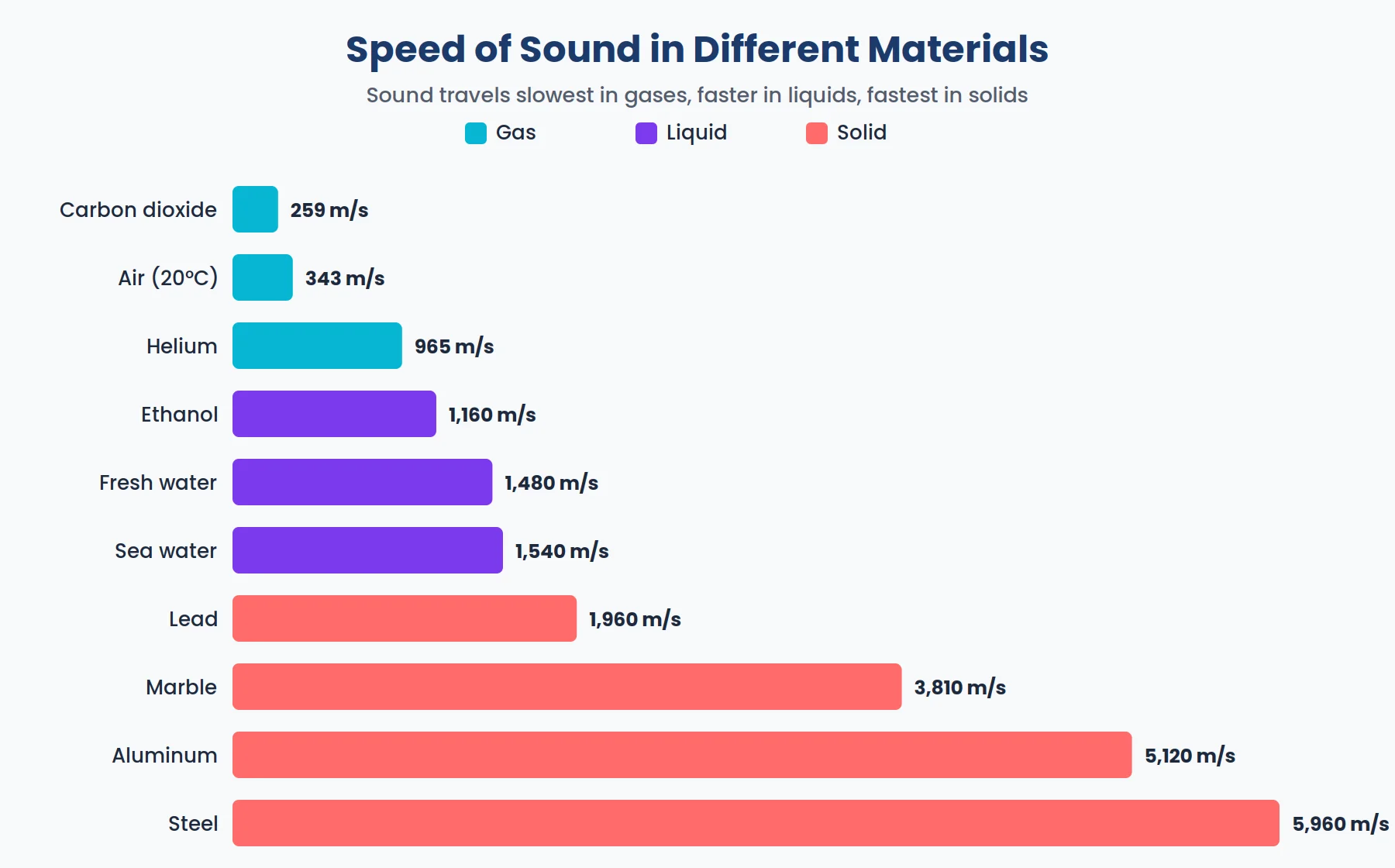
The rule that falls out of this surprises most people: sound travels slowest in gases, faster in liquids, and fastest in solids. Solids are denser than gases, but they are also enormously stiffer, and stiffness wins. Steel is roughly a million times stiffer than air, which is why sound races through steel about fifteen times faster than through the atmosphere.

Bar chart of the speed of sound in different materials, colour-coded by state: gases carbon dioxide 259 m/s, air 343 m/s and helium 965 m/s; liquids ethanol 1,160 m/s, fresh water 1,480 m/s and sea water 1,540 m/s; solids lead 1,960 m/s, marble 3,810 m/s, aluminium 5,120 m/s and steel 5,960 m/s
Stiffness beats density: sound is slowest in gases and fastest in solids.

Speed of sound in different materials

Values at standard conditions. Sound travels through fresh water at about 1,480 m/s, more than four times its speed in air; in steel it reaches nearly 6,000 m/s. Human tissue transmits sound at around 1,540 m/s, very close to water — which is precisely what makes medical ultrasound imaging possible.

MediumStateSpeed (m/s)
Carbon dioxideGas259
Air (0 °C)Gas331
Air (20 °C)Gas343
HeliumGas965
EthanolLiquid1,160
HydrogenGas1,290
MercuryLiquid1,450
Fresh waterLiquid1,480
Sea waterLiquid1,540
Human tissueLiquid-like1,540
LeadSolid1,960
MarbleSolid3,810
AluminiumSolid5,120
Glass (Pyrex)Solid5,640
SteelSolid5,960

How temperature changes the speed of sound

Warmer air carries sound faster because the molecules move more quickly and pass compressions along sooner. Every degree Celsius adds roughly 0.6 m/s.

343.4m/sv = 331.3 + 0.606 × 20

At 0 °C the formula gives 331 m/s; at 20 °C it gives about 343 m/s, the value usually quoted as the everyday speed of sound. On a winter day at −40 °C sound slows to about 307 m/s, and at 40 °C it speeds up to around 355 m/s. This temperature dependence is one reason sound behaves strangely across layers of warm and cold air, bending and carrying much farther under the right conditions.

Real Life

Longitudinal wave examples

Longitudinal waves surround us constantly, even though we rarely think about them — from everyday experience to advanced science and medicine.

Sound in air
Seismic P-waves
Medical ultrasound
Spring & Slinky pulses
Sonar
Animal echolocation

Sound waves

The most common longitudinal wave in daily life. A guitar string, a drumhead, a vocal cord or a loudspeaker cone pushes and pulls on the surrounding air, sending a train of compressions and rarefactions outward until it reaches your ear. Speed and behaviour depend on the medium and its temperature.

Seismic P-waves

The fastest seismic waves, travelling at 6 to 13 km/s. A P-wave compresses and stretches rock along its direction of travel — a sound wave moving through solid ground. They arrive first at seismograph stations, which is why they are called primary waves.

Ultrasound

Sound above 20,000 Hz, beyond the reach of human hearing. Medical scanners work between 1 and 20 MHz, sending longitudinal pulses into the body and timing the echoes that bounce off tissue boundaries. Because tissue carries sound at about 1,540 m/s, echo timing converts precisely into depth.

Spring and Slinky vibrations

The classic classroom demonstration. Push and pull one end of a stretched spring along its length and you can watch compressions of bunched coils travel to the far end, separated by rarefactions where the coils spread apart. Slow enough to see what sound does invisibly.

Sonar

Ships and submarines send out a pulse of sound and listen for the echo returning from the seafloor or another object. Measuring the round-trip time gives the distance. Sound works underwater where light and radio waves cannot reach far.

Echolocation

Bats and dolphins emit high-frequency longitudinal pulses and read the returning echoes to find prey and avoid obstacles in complete darkness — the same principle as sonar, evolved independently.

Human Hearing

The frequency ranges of sound

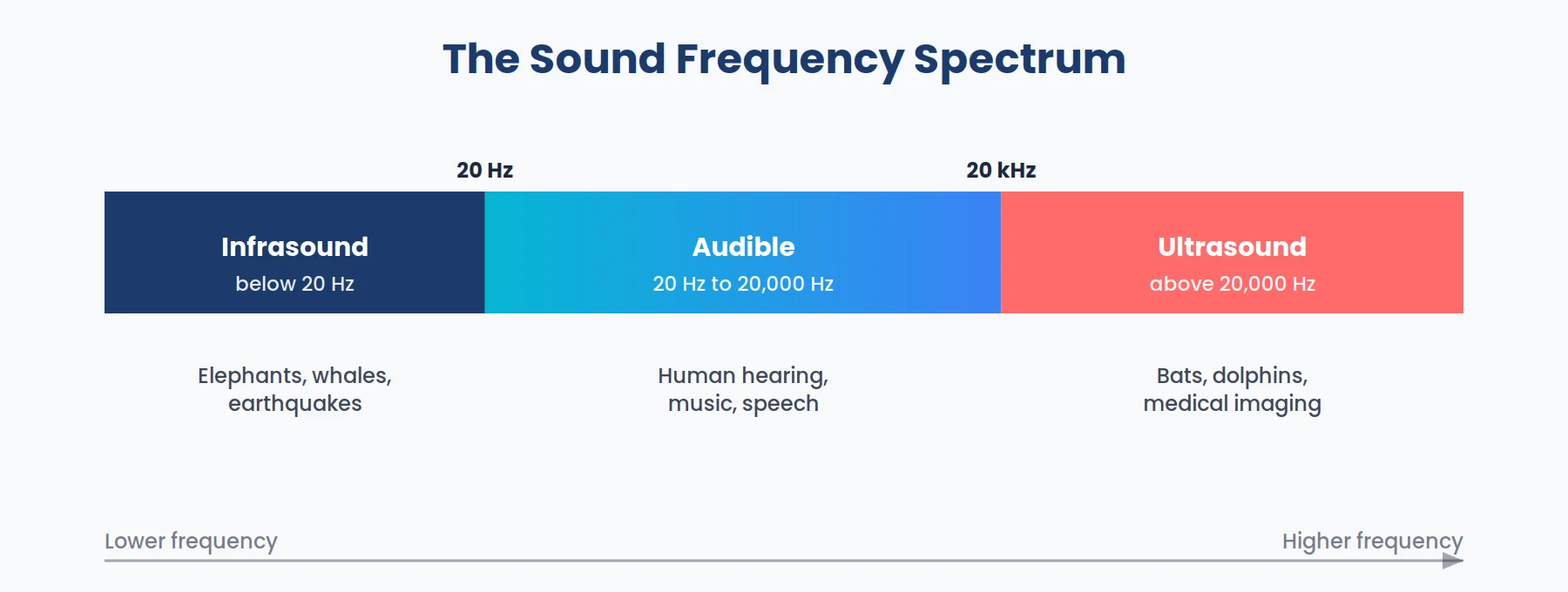
Not every longitudinal sound wave can be heard. Our ears respond only to a specific band, and waves above and below it have their own names and uses.

The sound frequency spectrum divided into three bands: infrasound below 20 Hz used by elephants, whales and earthquakes; audible sound from 20 Hz to 20,000 Hz covering human hearing, music and speech; and ultrasound above 20,000 Hz used by bats, dolphins and medical imaging

Infrasound

Below 20 Hz

Too low to hear, though we sometimes feel it as vibration. Produced by earthquakes, volcanoes and severe storms. Elephants and whales use it to communicate over long distances; rhinoceroses call as low as 5 Hz.

  • Rhino calls ~5 Hz
  • Elephant rumbles
  • Earthquakes

Audible sound

20 Hz – 20,000 Hz

The band a healthy young human can hear, most sensitive around 2,000–5,000 Hz. The range is widest in childhood and narrows with age as the hair cells of the inner ear lose their high-frequency response — a process called presbycusis.

  • Human voice 85–255 Hz
  • Middle C 261.6 Hz
  • Piano 27–4,186 Hz

Ultrasound

Above 20,000 Hz

Inaudible to us but not to everyone. Bats and dolphins echolocate here, and moths evolved ears tuned to the squeaks of hunting bats. Medicine and industry put the same frequencies to work.

  • Bats 20–200 kHz
  • Medical imaging 1–20 MHz
  • Industrial testing
Comparison

Longitudinal waves vs transverse waves

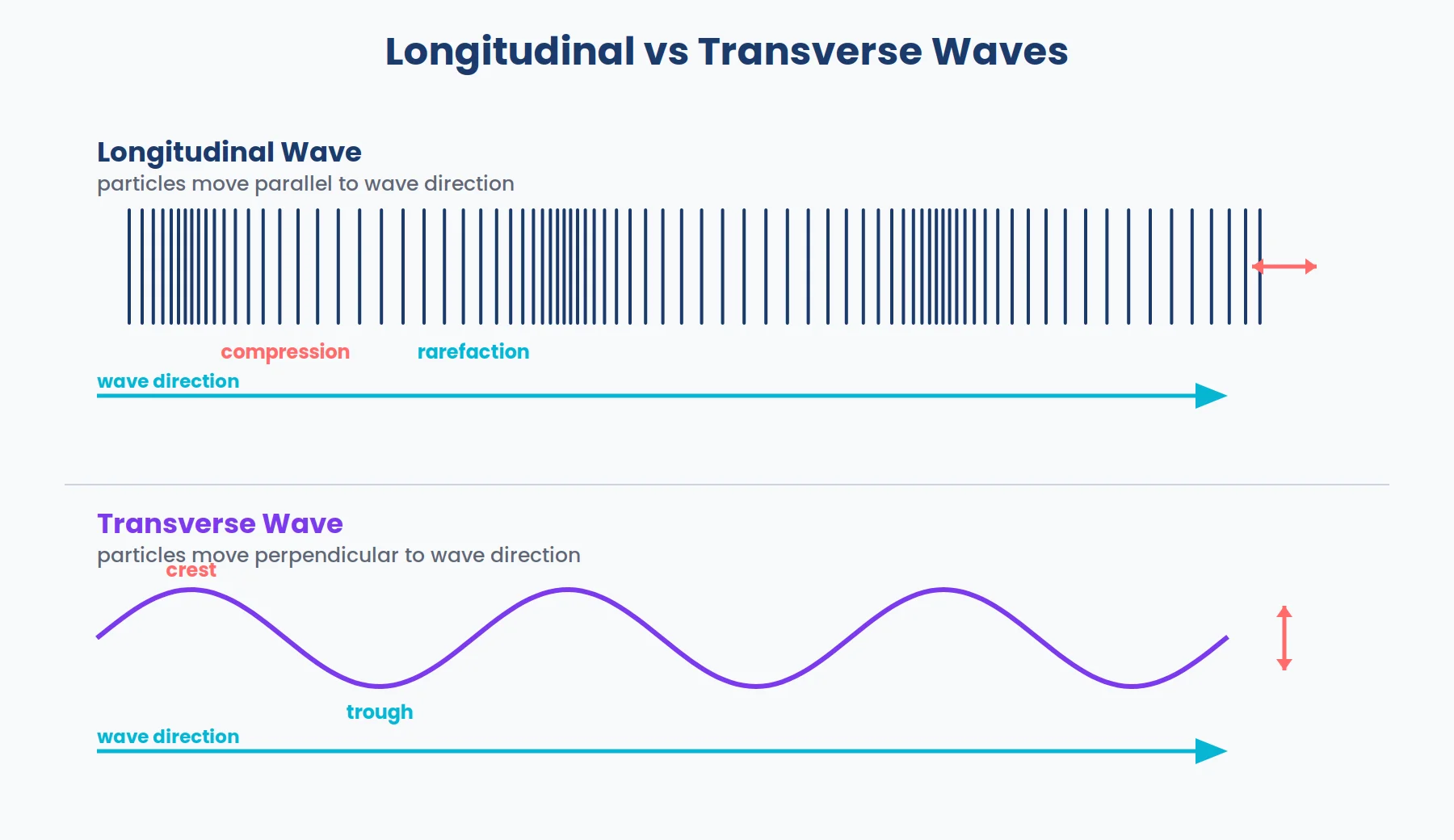
The two fundamental types of wave differ in exactly one thing: the direction the medium oscillates relative to the direction the wave travels. In a longitudinal wave the particles move parallel to propagation, building compressions and rarefactions. In a transverse wave they move perpendicular to it, building crests and troughs — the subject of the full guide to transverse waves.

Longitudinal versus transverse waves compared: the longitudinal wave is drawn as particles bunching into compressions and spreading into rarefactions with motion parallel to the wave direction, while the transverse wave is drawn as a sine curve with crests and troughs and motion perpendicular to the wave direction
Same direction of travel, same energy transfer — only the direction the medium moves is different.
PropertyLongitudinal waveTransverse wave
Particle motionParallel to wave directionPerpendicular to wave direction
Wave featuresCompressions and rarefactionsCrests and troughs
Can be polarized?NoYes
Needs a medium?AlwaysElectromagnetic types: no

Why sound cannot be polarized

Polarization restricts a wave's oscillation to a single plane, and it is only possible for transverse waves. In a longitudinal wave the particles oscillate along one axis only — the direction of travel. There is no sideways component to restrict or filter.

A polarizing filter works by blocking every oscillation direction except one. A longitudinal wave already has just one direction of oscillation, so there is nothing for the filter to remove. You can polarize light with a pair of sunglasses; there is no such thing as a sound polarizer. The impossibility of polarizing sound is one of the clearest pieces of evidence that it is a longitudinal wave.

Side-by-side simulation, the full property matrix, the maths the two wave types share and the odd cases that are somehow both are all on transverse vs longitudinal waves.

Seismology

P-waves and the structure of the Earth

Some of the most powerful evidence about the inside of our planet comes from longitudinal waves. An earthquake sends both longitudinal P-waves and transverse S-waves deep into the Earth, and the way they behave has revealed its hidden layers.

P-waves, being compression waves, travel through solids, liquids and gases alike. S-waves, being transverse shear waves, cannot travel through liquid at all, because liquids cannot resist the sideways shearing motion a transverse wave requires.

Seismologists noticed that after a large earthquake, P-waves were detected all around the globe, but S-waves vanished beyond a certain distance from the epicentre. The only explanation was a liquid layer deep inside, blocking the transverse waves while letting the longitudinal ones through. Richard Dixon Oldham drew that conclusion in 1906, and Beno Gutenberg pinned down the core's boundary in 1913.

The story goes deeper still. By studying faint P-waves appearing where none should have been, the Danish seismologist Inge Lehmann discovered in 1936 that a solid inner core sits nested within the liquid outer core. No one has ever drilled anywhere near it — the deepest borehole reached about 12 km.

The four wave types an earthquake produces, the shadow zones they leave, and how seismologists turn them into a location and a magnitude are covered on seismic waves.

Doppler Effect

Why a passing siren changes pitch

The Doppler effect is the change in a wave's observed frequency when the source and observer move relative to each other, and it is most familiar with sound. An ambulance racing toward you sounds higher-pitched than normal; as it passes and speeds away, the pitch drops. The siren itself never changes.

Each ring is one compression leaving the source. Ahead of the source they bunch up — more arrive per second, so the pitch rises. Behind it they stretch out and the pitch falls.

As the source moves toward you, each successive compression is emitted from a slightly closer position, so compressions arrive more frequently and the pitch sounds higher. As it moves away, the compressions stretch out, arrive less often, and the pitch sounds lower.

This is not just a curiosity. It is the working principle behind Doppler ultrasound, which measures the frequency shift of sound bouncing off moving red blood cells so doctors can assess circulation, detect blockages and monitor a baby's heartbeat. Police radar guns and weather radar use the same principle, though with transverse electromagnetic waves rather than sound.

History

The study of sound, and one famous mistake

The history of longitudinal waves is really the history of sound — including one of the most famous errors in physics and the elegant correction that finally fixed it.

  1. ~400 BCEArchytas proposes that higher-pitched sounds travel faster than lower ones. The idea is accepted for centuries, and it is wrong — every pitch travels at the same speed through a given medium.
  2. 1635Pierre Gassendi times the delay between a gun's flash and its bang across a measured distance, one of the first experimental estimates of the speed of sound in air.
  3. 1687Isaac Newton publishes the first mathematical calculation of the speed of sound in the Principia, deriving about 298 m/s. It is a landmark — and roughly 15 percent too low.
  4. 1816Pierre-Simon Laplace realises the compressions happen far too fast for heat to escape. Redoing Newton's work adiabatically, with the adiabatic index, brings theory and experiment into agreement.
  5. 1826Jean-Daniel Colladon strikes an underwater bell on Lake Geneva and measures sound in water at roughly 1,435 m/s — the first accurate measurement in a liquid, and close to the modern value.
  6. 1842Christian Doppler predicts that motion between a source and an observer shifts the observed frequency — the effect behind a passing siren and, later, Doppler ultrasound.
  7. 1906Richard Dixon Oldham notices that S-waves vanish beyond a certain distance while P-waves keep arriving, and infers that Earth has a core. Gutenberg locates its boundary in 1913.
  8. 1936Inge Lehmann finds faint P-waves arriving where none should, and concludes a solid inner core sits nested inside the liquid outer core.

Newton's calculation and its famous error

In 1687 Isaac Newton published the first mathematical calculation of the speed of sound in the Principia. Using the new tools of calculus he treated sound as a pressure wave and derived about 298 m/s — the first time anyone had calculated a wave's speed from theory alone.

There was a problem. His answer was roughly 15 percent below careful experimental measurements, and the error came from a hidden assumption: Newton believed the air stayed at constant temperature as the wave compressed it, a condition physicists call isothermal. He assumed any heat produced by compression had time to flow away. It does not, and the discrepancy stayed unsolved for well over a century.

Laplace's correction

In 1816 Pierre-Simon Laplace realised the compressions and rarefactions happen far too quickly for heat to escape. The air heats slightly when compressed and cools slightly when rarefied — an adiabatic process rather than an isothermal one. Redoing Newton's calculation with the adiabatic index brought theory and experiment into near-perfect agreement.

The Laplace correction is a classic example of how a single wrong assumption can hide inside otherwise brilliant work for generations. Newton's genius built the framework; it took Laplace's insight about heat to complete it.

Music

Standing waves and musical instruments

Longitudinal waves are responsible for the sound of wind instruments. Trap a longitudinal wave inside a tube — a flute, a clarinet, an organ pipe — and it reflects back and forth, overlapping with itself to form a standing wave.

A standing wave appears when a wave travelling one way overlaps its own reflection travelling the other way. In a column of air this produces fixed patterns of compression and rarefaction. Only certain frequencies fit neatly inside the length of the tube, and those allowed frequencies are the instrument's notes.

The lowest frequency that fits is the fundamental, which sets the pitch. Higher frequencies — harmonics or overtones — occur at whole-number multiples of it. The particular blend of harmonics gives an instrument its tone, which is why a flute and a trumpet playing the same note sound completely different. Changing the effective length of the air column changes which standing waves can form, and that is the physics behind covering holes on a flute or pressing valves on a trumpet.

Reference

Key equations

v = f × λThe universal wave equation — speed equals frequency times wavelength
T = 1 / fPeriod is the reciprocal of frequency
v = √(E / ρ)Speed in a medium, where E is the elastic modulus and ρ the density
v = 331.3 + 0.606 × TSpeed of sound in air, with T in degrees Celsius
E ∝ A²Energy is proportional to amplitude squared — double the amplitude, quadruple the energy
Practice

Worked examples

Wave speed from frequency and wavelength

A sound wave in air has a frequency of 170 Hz and a wavelength of 2 metres. What is its speed?

v = f × λ = 170 × 2 = 340 m/s

Period from frequency

A longitudinal wave has a frequency of 500 Hz. What is its period?

T = 1 / f = 1 / 500 = 0.002 s

Speed of sound at a given temperature

What is the speed of sound in air at 25 °C?

v = 331.3 + 0.606 × 25 = 346.5 m/s

Wavelength of a musical note

The note A has a frequency of 440 Hz. If sound travels at 343 m/s in the room, what is its wavelength?

λ = v / f = 343 / 440 ≈ 0.78 m

How amplitude affects energy

If the amplitude of a sound wave doubles while its frequency stays the same, how does the energy change?

E ∝ A², so 2² = 4 — the energy increases fourfold

Applications

Longitudinal waves at work

Longitudinal wave physics is not confined to the classroom. It powers major industries in medicine, defence, manufacturing and energy exploration.

Medical ultrasound imaging

Scanners send high-frequency longitudinal pulses into the body and build live images from the echoes, with no radiation and no surgery. The global ultrasound market was worth roughly $8–10 billion in 2025 and is projected to reach about $16 billion by the mid-2030s. Diagnostic ultrasound makes up close to 80 percent of it.

Doppler ultrasound

Measuring the frequency shift of sound reflected from moving red blood cells lets doctors assess circulation, diagnose vascular disease and monitor a baby's heartbeat. The Doppler ultrasound market was valued at approximately $2.6–3 billion in 2025.

Sonar and underwater detection

Sound travels efficiently through water where light and radio waves do not, which makes longitudinal pressure waves the primary tool for underwater sensing — navigation, submarine detection, fishing and mapping the ocean floor.

Non-destructive testing

Ultrasonic pulses sent into metal beams, welds, pipelines and aircraft components reflect off internal cracks and voids. The technique finds hidden defects before they cause failures, without damaging the part.

Seismology and energy exploration

Seismologists read natural P-waves to study earthquakes and Earth's interior. The oil and gas industry generates artificial seismic waves and reads their reflections to map rock formations far below the surface.

FAQ

Frequently asked questions about longitudinal waves

What is a longitudinal wave in simple words?

A longitudinal wave is a wave where the particles of the medium move back and forth in the same direction the wave travels. Push and pull one end of a Slinky and the coils squeeze together and stretch apart along its length, and that pattern moves down the spring. Sound works the same way, with air molecules vibrating back and forth along the direction the sound is going.

What are five examples of longitudinal waves?

Sound waves travelling through air, ultrasound used in medical imaging, seismic P-waves produced by earthquakes, pressure waves along a stretched spring or Slinky, and the sound pulses used in sonar. In every case the medium vibrates parallel to the direction the wave moves.

Is sound a longitudinal wave?

Yes. Sound is the most common example of a longitudinal wave. As it travels, the molecules of the medium compress and expand along the same direction the wave moves, creating alternating regions of high and low pressure called compressions and rarefactions. This is also why sound cannot be polarized and cannot travel through a vacuum.

What are compressions and rarefactions?

They are the two alternating regions that make up a longitudinal wave. A compression is a region where the particles are squeezed close together, producing higher pressure and density. A rarefaction is a region where the particles are spread apart, producing lower pressure and density. The two zones travel through the medium one after another as the wave propagates.

Can longitudinal waves travel through a vacuum?

No. Longitudinal waves always require a medium because they are physical compressions of matter. Without particles to squeeze together and spread apart, there is nothing to carry the wave. This is why sound cannot travel through the vacuum of space, while light, a transverse electromagnetic wave, crosses empty space with no difficulty.

Can longitudinal waves travel through liquids and gases?

Yes. Longitudinal waves travel easily through solids, liquids and gases, because all matter can be compressed. Sound moves through air, through water and through steel, and seismic P-waves pass through both the solid mantle and the liquid outer core. This is a major difference from transverse mechanical waves, which cannot pass through the interior of liquids and gases.

Why does sound travel faster in solids than in gases?

Because solids are far stiffer. The speed of a longitudinal wave depends on the ratio of a material's stiffness to its density, and stiffness has the larger effect. Although solids are denser than gases, they are enormously more rigid, which lets them pass compressions along much faster. Sound travels through steel at nearly 6,000 m/s, about fifteen times faster than through air.

What is the speed of sound in air?

About 343 m/s in dry air at 20 °C. The value rises by roughly 0.6 m/s for every degree Celsius increase, so at 0 °C sound travels at about 331 m/s. A useful formula is v = 331.3 + 0.606 × T, where T is the temperature in degrees Celsius.

What is the wavelength of a longitudinal wave?

The distance between the centres of two consecutive compressions, or equally between two consecutive rarefactions. It is measured in metres and is exactly analogous to the crest-to-crest distance in a transverse wave. Wavelength connects to frequency and speed through v = f × λ.

Are seismic waves longitudinal or transverse?

Earthquakes produce both. P-waves, or primary waves, are longitudinal and arrive first because they travel fastest, between 6 and 13 km/s. S-waves, or secondary waves, are transverse and arrive later. The fact that longitudinal P-waves pass through liquid while transverse S-waves cannot is what revealed Earth's liquid outer core.

Why can't longitudinal waves be polarized?

Because their particles oscillate along only one axis, the direction of travel. Polarization works by filtering out all directions of oscillation except one, but a longitudinal wave already vibrates in just a single direction, so there is nothing to filter. Only transverse waves, which oscillate in a plane perpendicular to their travel, can be polarized. This is one of the clearest proofs that sound is a longitudinal wave.
Summary

Key takeaways

Longitudinal waves are defined by parallel oscillation: the medium vibrates in the same direction the wave travels. Instead of crests and troughs they are built from compressions, where particles pack together, and rarefactions, where they spread apart.

Sound is the most important longitudinal wave, and its behaviour depends on the medium and temperature. It travels slowest in gases, faster in liquids and fastest in solids — about 343 m/s in air, roughly 1,480 m/s in water and nearly 6,000 m/s in steel. Longitudinal waves always require a medium, which is why sound cannot cross the vacuum of space, and they cannot be polarized, which is a key proof of their nature.

The universal wave equation v = fλ applies to all of them. Speed in a medium follows v = √(E/ρ), balancing stiffness against density, and in air it can be estimated with v = 331.3 + 0.606 × T.

From Newton's flawed calculation in 1687 to Laplace's adiabatic correction in 1816, and from seismic P-waves mapping Earth's core to a global ultrasound industry worth billions, longitudinal wave physics has shaped both science and technology. Understanding these waves explains how we hear, how we see inside the human body, how ships navigate the ocean depths, and how we learned to read the hidden interior of our own planet.